
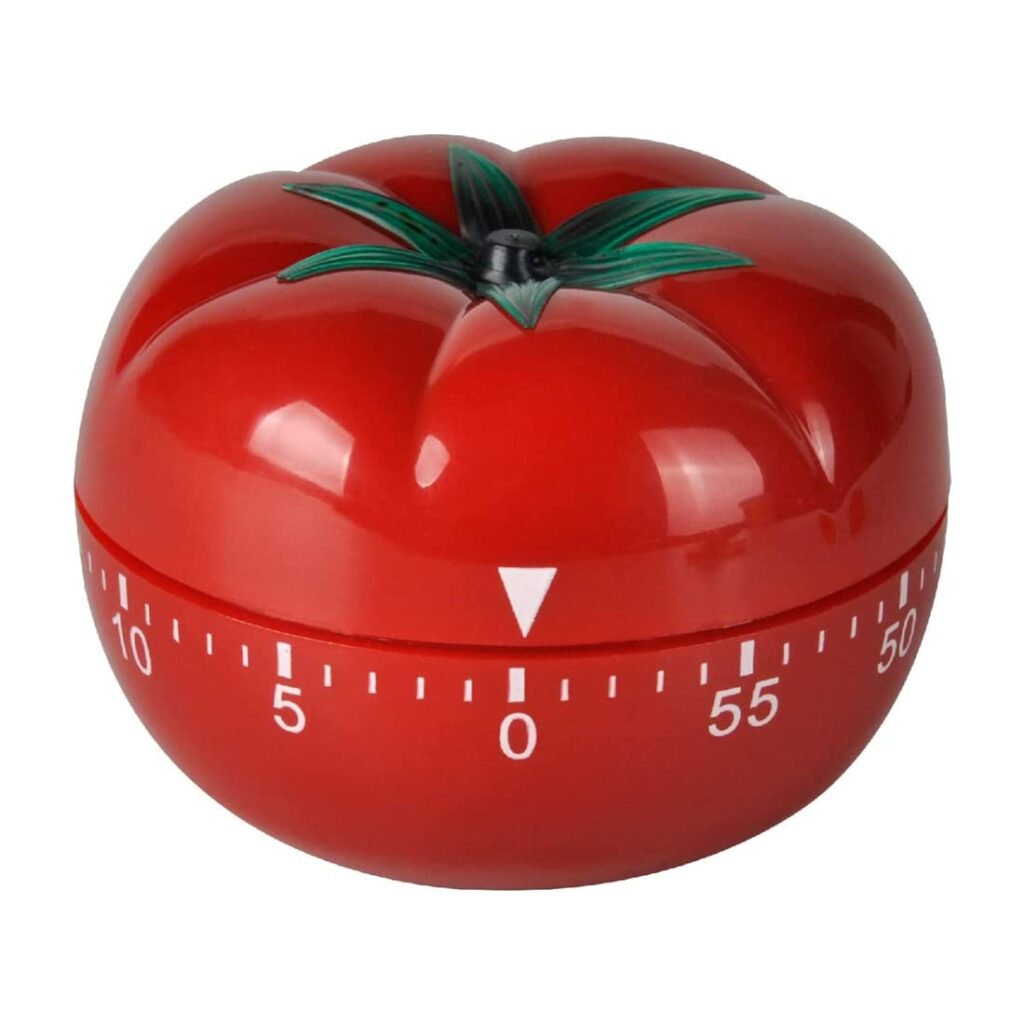
The Pomodoro Technique: The Ultimate Guide to Time Management in 25-Minute Sprints. Of all the time management techniques developed in the modern era, few have achieved the global adoption, scientific validation, and practical simplicity of the Pomodoro Technique. Used by millions of students, software engineers, writers, executives, and entrepreneurs worldwide, this deceptively simple method has transformed how people relate to focused work — converting overwhelming workloads into conquerable, confidence-building intervals.
🍅 The Origin Story
In the late 1980s, a university student named Francesco Cirillo was struggling to focus on his studies. Frustrated by constant distraction and procrastination, he grabbed a tomato-shaped kitchen timer from his university kitchen — a pomodoro in Italian — and made himself a challenge: focus for just 10 minutes. That experiment evolved into a formal system. By 1992, Cirillo had documented the method in detail, and by the 2000s, it had spread across the world’s most productive workplaces. The humble kitchen timer became one of the most powerful symbols in modern productivity culture.
Why the Pomodoro Technique Works: The Science Behind the Sprints
The Pomodoro Technique is not just a feel-good routine — it is grounded in well-established principles of cognitive science and behavioural psychology. Understanding why it works makes it far easier to apply consistently and adapt intelligently.
Time pressure activates performance. Psychologists refer to this as the Yerkes-Dodson Law: a moderate level of arousal — including mild time pressure — produces optimal cognitive performance. The ticking 25-minute countdown creates just enough urgency to override procrastination without generating the paralysing anxiety of a distant deadline. Your brain shifts into an execution-focused state rather than deliberating indefinitely about where to begin.
Forced breaks prevent cognitive fatigue. Sustained attention is a finite resource. Research in neuroscience has demonstrated that prolonged focus on a single task leads to a phenomenon called directed attention fatigue — the gradual degradation of concentration quality, decision-making accuracy, and creative thinking. The mandatory short breaks built into the Pomodoro cycle allow the brain’s default mode network to activate, facilitating consolidation of information, creative connection-making, and emotional regulation before the next work session begins.
The completion effect boosts motivation. Every time you finish a Pomodoro and mark it done, your brain receives a small dose of dopamine — the neurotransmitter associated with reward and motivation. This positive reinforcement loop creates a self-sustaining cycle: completing work intervals feels satisfying, which makes you more likely to start the next one. Over time, beginning a Pomodoro becomes an ingrained, low-friction habit rather than a willpower-intensive decision.
25min
Standard Pomodoro work interval for optimal focus
16M+
People worldwide who use the Pomodoro technique daily
4x
Pomodoros completed before a long restorative break
The Pomodoro Technique: Step-by-Step Instructions
The beauty of the Pomodoro Technique lies in its structured simplicity. Here is the complete, authoritative breakdown of how to implement it correctly — from choosing your task to completing a full daily cycle.
Step 1 🎯Choose a Single, Specific Task
Before setting your timer, identify exactly what you will work on during the Pomodoro. Vague intentions produce vague results. Instead of writing “work on report,” write “draft the executive summary section of the Q2 report.” The more specific your task definition, the easier it is to enter a focused state and evaluate whether you succeeded at the end of the interval.
If your task is large and will take multiple Pomodoros, break it into clearly defined sub-tasks and assign one sub-task per Pomodoro. This prevents the paralysing uncertainty of staring at an enormous project without knowing where to begin.
Pro Tip: Write your task on a physical notepad next to your timer. The act of writing anchors your intention and gives you a satisfying item to cross off when the Pomodoro completes.
Step 2 ⏱️Set Your Timer for 25 Minutes
Set a countdown timer for exactly 25 minutes. Cirillo chose 25 minutes through experimentation as the optimal interval — long enough to make meaningful progress on a complex task, but short enough to maintain intensity and manage the discomfort of sustained focus. The act of setting the timer is itself a commitment ritual: it signals to your brain that work mode has officially begun.
You can use a physical kitchen timer (Cirillo’s original preference — the physical winding action reinforces commitment), a dedicated app like Forest, Be Focused, or Toggl Track, or a simple smartphone timer. Many practitioners prefer a physical timer because the audible ticking creates an ambient sense of accountability that digital timers lack.
Tool Recommendation: Forest (iOS/Android) gamifies the Pomodoro by growing a virtual tree during each session. If you leave the app, your tree dies — a surprisingly effective psychological deterrent against distraction.
Step 3 🧠Work with Complete, Undivided Focus
Once the timer starts, all of your attention goes to the single task you defined. This is the heart of the Pomodoro Technique — and the step most people underestimate. True focused work means no checking email, no glancing at your phone, no switching tabs, no responding to colleagues, and no following tangential thoughts down internet rabbit holes.
Distractions will arise — both external (a colleague knocking, a phone notification) and internal (suddenly remembering you need to call someone, or a new idea surfacing mid-task). The Pomodoro Technique has a specific protocol for each:
- Internal distractions: Use the “Inform, Negotiate, Call Back” strategy. Write the intrusive thought on a notepad (to externalise it and stop mentally looping on it), then return immediately to your task. Address it during your break.
- External interruptions: Politely inform the person you’re in a focused session and will get back to them in X minutes. If the interruption is truly urgent, it is acceptable to abandon the Pomodoro — but this should be the exception, not the rule.
- Unavoidable interruption rule: If a Pomodoro is broken before the 25 minutes are up, it doesn’t count. Start a fresh one. This rule preserves the integrity of the session and trains you to protect your focus windows.
Step 4 ☕Take a Genuine 5-Minute Short Break
When the timer rings at 25 minutes, stop working immediately — even if you’re mid-sentence or on a roll. Then take a deliberate, restorative 5-minute break. The break is not optional, and it is not a reward for finishing — it is an integral component of the technique that makes the next Pomodoro possible at full capacity.
Critically, the break must actually be restful. Scrolling social media, checking email, or having a complex conversation do not allow the cognitive reset the break is designed to deliver. Instead, use your short breaks for:
- Standing up, stretching, or walking briefly around the room
- Looking at a distant object or out of a window to relax eye muscles
- Making a drink or getting a small snack
- Light breathing exercises or a brief mindfulness moment
- Simple physical movement — jumping jacks, shoulder rolls, or neck stretches
After the break, set the timer again and begin the next Pomodoro with a fresh task or the continuation of your current one.
Step 5 🔄Repeat the Cycle
Continue the rhythm of 25 minutes of focused work followed by 5 minutes of recovery. Each completed work interval is one Pomodoro. Track your completed Pomodoros with a simple tally on your notepad — this record serves both as a motivational tool and a valuable data source for understanding your personal productivity patterns. Over time, you will discover how many Pomodoros different types of tasks typically require, allowing you to plan your day with far greater accuracy.
Looking to transform your Money-Draining House into a tiny profitable Off-The-Grid Homestead? Check our The Self-Sufficient Backyard: For The Independent Homesteader
Step 6 🌿Take a Long Break After Every Four Pomodoros
After completing four consecutive Pomodoros — roughly two hours of focused work — take a longer restorative break of 15 to 30 minutes. This is the most important recovery investment in the entire cycle, and it is where most people shortchange themselves. After sustained cognitive effort across four intervals, your brain genuinely needs a deeper reset than 5 minutes can provide.
Use your long break for genuine recovery activities: a walk outside (sunlight and movement together produce a powerful neurological reset), a proper meal, a short nap (10–20 minutes has been shown to restore alertness for 1–3 hours), or any activity that is meaningfully different from knowledge work. The quality of your next set of four Pomodoros depends directly on how well you use this break.
Scientific Basis: Research on ultradian rhythms — the brain’s natural 90–120 minute cycles of higher and lower alertness — supports the logic of the long break. Four 25-minute Pomodoros plus three 5-minute breaks total approximately 115 minutes, aligning almost exactly with the end of one natural ultradian cycle. The long break coincides with the brain’s own biological signal to recover.
A Full Pomodoro Cycle at a Glance
🍅
25 min
Work
☕
5 min
Break
🍅
25 min
Work
☕
5 min
Break
🍅
25 min
Work
☕
5 min
Break
🍅
25 min
Work
☕
15 -30 min
Long Break
= 1 Complete Pomodoro Set (~2 hours of focused output)
Benefits of the Pomodoro Technique: Why It Consistently Outperforms Traditional Work Habits
The Pomodoro Technique delivers measurable improvements across several dimensions of performance that conventional, unstructured work cannot match. Here is a detailed examination of the core benefits — and why each one matters for long-term productivity:
| Benefit | How It Works | Who Benefits Most |
| Conquers Procrastination | Committing to just 25 minutes is psychologically far less daunting than “working on a project.” The small, bounded commitment overrides the brain’s avoidance instinct. | Students, creative professionals, anyone with open-ended projects |
| Reduces Anxiety Around Large Tasks | Decomposing complex projects into Pomodoro-sized chunks makes the scale of work feel manageable rather than overwhelming. Progress is visible and immediate. | Project managers, researchers, writers, developers |
| Improves Time Estimation | Tracking Pomodoros per task over weeks reveals how long different work types actually take — dramatically improving scheduling accuracy and deadline management. | Freelancers, consultants, anyone who bills hourly or manages multiple projects |
| Sustains Concentration Quality | Mandatory breaks prevent the slow degradation of focus quality that occurs during uninterrupted long sessions, maintaining output quality across an entire workday. | Anyone doing cognitively intensive work for more than 2 hours |
| Creates Accountability | The countable, trackable nature of Pomodoros makes it easy to review daily output objectively — replacing vague feelings of “I worked a lot” with concrete evidence of effort. | Remote workers, self-employed professionals, students |
| Builds Distraction Awareness | Logging every interruption that occurs during Pomodoros reveals patterns — which distractions are most frequent, when they tend to occur, and which are truly unavoidable. | Anyone in a high-distraction environment |
Adapting the Pomodoro Technique to Your Work Style
One of the most common mistakes new practitioners make is treating the 25-minute interval as sacred and immovable. Cirillo himself designed the technique as a framework to be personalised, not a rigid prescription. Research on attention spans and individual differences in cognitive stamina suggests that the optimal interval varies significantly between people and task types.
If you find that 25 minutes consistently cuts your flow state short — the experience of deep, effortless, highly productive engagement with a task — experiment with extending your intervals. Many experienced practitioners settle into 45-minute or even 90-minute work blocks with proportionally longer breaks. The core principles remain intact: defined intervals, mandatory recovery, and tracked completion. What changes is the calibration to your personal cognitive rhythms.
Conversely, beginners to focused work or individuals with attention difficulties such as ADHD may find 25 minutes too long initially. Starting with 10 or 15-minute Pomodoros and gradually extending them over several weeks is a well-validated approach to building sustained concentration as a trainable skill.
Pomodoro Adaptation Guide: Beginners or ADHD → start at 10–15 minutes. Standard knowledge work → 25 minutes (classic Pomodoro). Deep creative or technical work → 45–50 minutes. Research or writing flow states → 60–90 minutes (often called “Flowmodoro”). Always maintain the ratio: approximately 1 part rest for every 4–5 parts work.
Common Pomodoro Mistakes (and How to Fix Them)
X
Mistake
Checking phone during short breaks
Social media and news feeds are cognitively stimulating, not restorative. Your break should involve low-stimulation activity. Leave your phone untouched until the long break.
X
Mistake
Working through the break
Skipping breaks feels productive in the moment but leads to faster fatigue. Trust the system: a 5-minute break now prevents a 45-minute slump later.
X
Mistake
Using Pomodoros for meetings or calls
The technique is designed for solo, cognitively demanding work. Collaborative activities follow different dynamics and don’t benefit from 25-minute constraints.
X
Mistake
Skipping the long break
The long break is where the deepest recovery occurs. Skipping it and continuing with short breaks produces rapidly diminishing returns on focus quality.
X
Mistake
Starting without a defined task
Setting the timer without deciding exactly what you’ll work on leads to a diffuse, unfocused session. Spend 60 seconds before each Pomodoro writing down your precise intention.
X
Mistake
Not tracking your Pomodoros
The data you collect by tracking daily Pomodoros is enormously valuable. Without records, you lose insights into your capacity, patterns, and progress over time.
The Pomodoro Technique for Students: Studying Smarter, Not Longer
For students facing exam preparation, essay deadlines, and research projects, the Pomodoro Technique offers a particularly compelling advantage: it converts passive, guilt-ridden study sessions into active, measurable work intervals. Instead of sitting at a desk for three hours while attention drifts in and out, a student using the Pomodoro Technique completes six focused 25-minute blocks — roughly the same clock time, but with dramatically higher retention and comprehension.
Educational research supports interval-based study over marathon sessions for the same reason spaced repetition works: the brain consolidates learning most effectively during rest periods between active study intervals. Each break functions as an informal memory consolidation window, making Pomodoro-based studying not just more sustainable, but more effective at encoding information into long-term memory.
Check our Top Productivity Hacks to Save Time and Achieve More
Pomodoro Technique vs. Other Time Management Methods
The Pomodoro Technique doesn’t exist in isolation — it is most powerful when understood alongside other time management strategies and used selectively based on context:
| Method | Best For | Works With Pomodoro? |
| Pomodoro Technique | Execution of defined, solo tasks | — |
| Time Blocking | Scheduling when to do different types of work | Yes — block Pomodoro sessions into your calendar |
| Eisenhower Matrix | Deciding what to work on | Yes — prioritise tasks first, then do them in Pomodoros |
| GTD (Getting Things Done) | Capturing and organising all tasks and projects | Yes — use GTD to define tasks, Pomodoro to execute them |
| Deep Work | Extended, immersive focus sessions (2–4 hours) | Partially — Pomodoro can structure deep work sessions |
“The Pomodoro Technique taught me that the timer doesn’t track time — it protects it.”
— Practitioner reflection on 5 years of consistent Pomodoro use
Getting Started with the Pomodoro Technique Today
You do not need any special equipment or setup to begin. Right now, you can:
- Write down the single most important task you need to complete today
- Set a timer on your phone for 25 minutes
- Put your phone face-down, close all irrelevant tabs, and begin
- When the timer rings, take 5 minutes away from your screen
- Repeat four times, then take a proper 20-minute break
- At the end of the day, count how many Pomodoros you completed and note what you accomplished
Do this consistently for two weeks and the compound effect on your focus, output, and relationship with work will be unmistakable. The Pomodoro Technique is not a productivity gimmick — it is one of the most rigorously field-tested, psychologically grounded, and universally applicable time management methods available to anyone who wants to get more done in less time, with less stress.
What is the Pomodoro Technique and how does it work?
The Pomodoro Technique is a time management method created by Francesco Cirillo in the late 1980s. It works by breaking work into 25-minute focused intervals (called “Pomodoros”) separated by 5-minute short breaks. After completing four Pomodoros, you take a longer restorative break of 15–30 minutes. The technique improves focus, reduces procrastination, and builds a measurable record of your daily output.
Why is it called the Pomodoro Technique?
The name comes from the Italian word for “tomato.” When Francesco Cirillo first developed the method as a university student, he used a tomato-shaped kitchen timer to time his study sessions. The timer gave the technique its iconic name, and the method has retained it ever since.
Can I change the 25-minute interval in the Pomodoro Technique?
Yes. While 25 minutes is the classic standard, Cirillo designed the technique as a framework to be personalised. Beginners and those with ADHD often benefit from shorter 10–15 minute intervals. Experienced practitioners doing deep creative or technical work frequently use 45–90 minute sessions. The core principle — defined work intervals followed by mandatory breaks — remains the same regardless of the interval length you choose.
What should I do during a Pomodoro break?
Use short breaks for low-stimulation, physically restorative activities: stretching, walking around the room, making a drink, looking out a window, or light breathing exercises. Avoid checking social media, email, or news — these activities are cognitively stimulating and prevent the neural reset that makes the next Pomodoro effective. Long breaks (after every 4 Pomodoros) can involve a proper walk outside, a meal, or a short nap.
Is the Pomodoro Technique effective for ADHD?
Yes — the Pomodoro Technique is widely regarded as one of the most ADHD-friendly productivity methods available. The short, bounded work intervals feel less threatening than open-ended tasks; the timer creates external structure and urgency; and the frequent breaks help manage restlessness. Many ADHD coaches recommend starting with 10–15 minute intervals and gradually increasing session length as focus capacity develops.
What is the single most effective productivity hack?
If forced to choose one, it’s planning your three Most Important Tasks (MITs) the night before and tackling the hardest one first thing in the morning. This single habit redirects your best energy toward what matters most and creates immediate momentum for the rest of the day.
How can I get more done in less time without burning out?
Sustainable high productivity requires balancing deep work with deliberate recovery. Work in focused 90-minute blocks, take real breaks, protect your sleep, and schedule non-work time as seriously as work time. Getting more done faster is not about working more hours — it’s about using your peak hours more deliberately.
What is time blocking and does it work?
Time blocking is the practice of assigning specific tasks to dedicated calendar slots rather than working from a to-do list. It works because it forces you to be realistic about how long tasks take, eliminates decision fatigue about what to do next, and protects your most important work from being displaced by reactive tasks.
How long does it take to build a productive habit?
Research from University College London found it takes an average of 66 days for a behaviour to become automatic — not the often-cited 21 days. Focus on one new habit at a time, attach it to an existing routine (habit stacking), and track your consistency for the first 10 weeks.
Can productivity hacks work for people with ADHD?
Yes, though some adjustments help. People with ADHD often respond especially well to the Pomodoro Technique (short, time-boxed sessions), body doubling (working alongside someone else), external accountability, and highly visual task management systems. Environmental design — removing distractions at the source — is particularly important.
Start Small. Build Systems. Stay Consistent.
You don’t need to implement all available hacks at once. Pick one technique from each section, practice it for two weeks, then layer in the next. Compound gains in productivity — just like compound interest — grow exponentially over time.